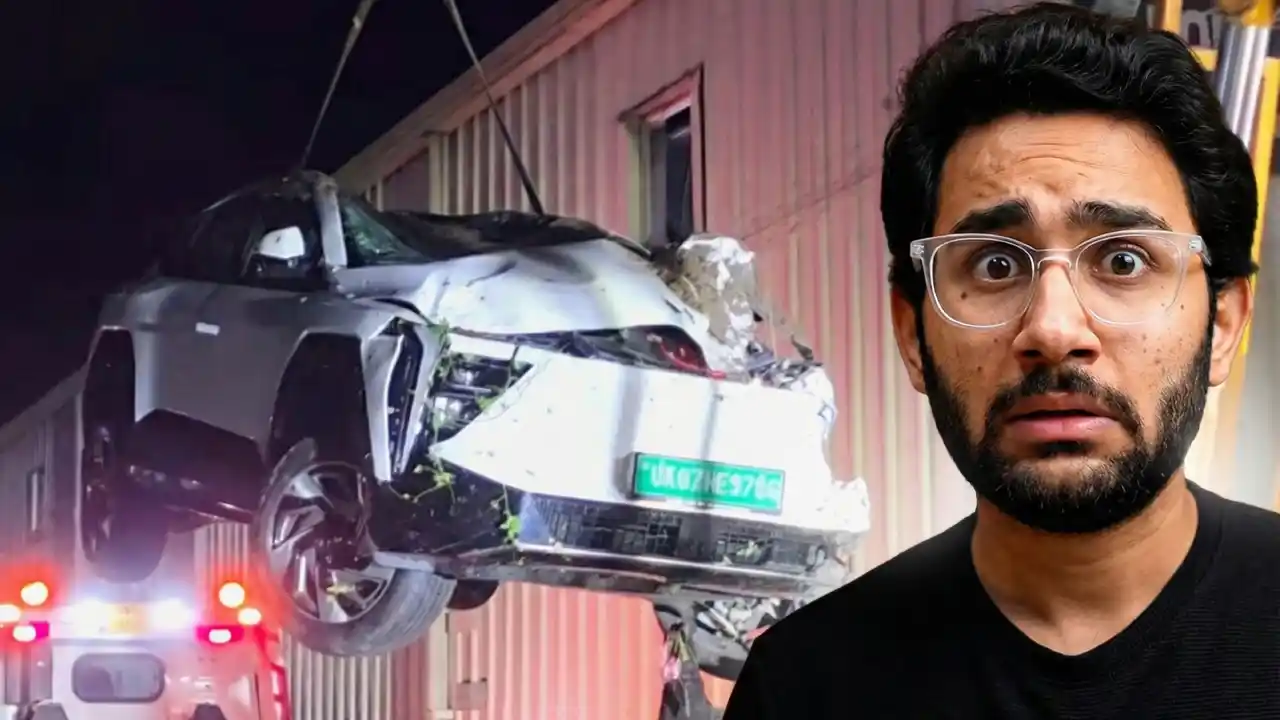
Popular tech influencer Shivam Arora, better known to millions as the face of Venom’s Tech, has sparked a massive debate online after documenting a harrowing five-month service battle with Mahindra following a near-fatal accident.
The tech YouTuber, who survived a terrifying cliff plunge in his brand-new Mahindra XEV 9e in Dehradun, took to social media to expose what he calls a total failure of after-sales support.
While the car’s build quality saved his life, the influencer claims the subsequent service experience was a nightmare that has left him afraid to drive his own vehicle.
The controversy began when the creator attempted to get his totalled vehicle repaired. Despite the car falling into a deep gorge and sustaining massive damage, the influencer says Mahindra’s workshop and insurance surveyors were in a state of total confusion.
Initial quotes for the repair reached a staggering 56 lakh rupees, yet the insurance company countered with only 11 lakh rupees, even misidentifying the vehicle model in official paperwork.
The YouTuber spent over a month fighting for a total loss claim, but he alleges that neither the service centre nor the insurance providers would budge, leaving him stuck with a 33 lakh rupee “experiment.”
Direct quotes from the influencer highlight a deep frustration with the lack of expertise at the service level. He mentioned that the workshop seemed to have no prior experience handling such a major loss for an electric vehicle, making his car the “guinea pig” for their technicians.
He even took to Instagram and YouTube to share that despite his status as a prominent reviewer, he had to use every bit of his influence just to get basic updates on the repair progress, leaving him wondering how the average consumer is treated.
The narrative took a shocking turn when the influencer finally went to collect his vehicle after 150 days of waiting. Instead of the “brand new” condition promised by customer care managers, he found a laundry list of safety hazards.
He showcased exposed, “naked” wiring inside the cabin, missing screws in the glovebox, and sensors that simply refused to function. In a particularly “breathless” revelation, he shared that when he turned on the AC, small particles of shattered glass from the original accident flew out of the vents and onto the seats.
Social media reactions have poured in, with many users echoing his concerns about the “untrained” staff at authorised service centers.
The creator pointed out that the paint job appeared as if it had been done at a “local street corner” rather than a professional facility, with visible brush marks and poor finishing.
He noted that even basic safety features, like a rear seatbelt lock, were missing when the car was handed back to him, raising serious questions about the quality checks performed by the brand.
Ultimately, the influencer revealed that his excitement for the vehicle has been replaced by a deep sense of “vahm”, or psychological dread. He expressed concern over the battery safety and the integrity of the electronic sensors after such a major, unprofessional rebuild.
He warned his followers that while the car is a tech marvel, the service infrastructure behind it may not be ready for the complexities of the EV revolution, especially when it comes to major accidents.
More Read


For those unfamiliar with the man behind the lens, Shivam Arora is a prominent Indian tech YouTuber who has built a massive community of over 1.4 million subscribers. His content style blends deep technical dives with a relatable, conversational humour that resonates with a tech-savvy audience across India and beyond.
Starting his journey with gaming setups, Shivam expanded his reach into the automotive space, bringing his signature eye for detail to the world of electric vehicles.
His recent survival story has shifted his content from consumer tech to consumer advocacy, as he uses his platform to highlight the gaps in India’s growing EV service infrastructure.
With a dedicated presence on YouTube and other social media, Shivam continues to be a vocal figure in the Indian creator economy, often bridging the gap between high-end technology and everyday user experiences.