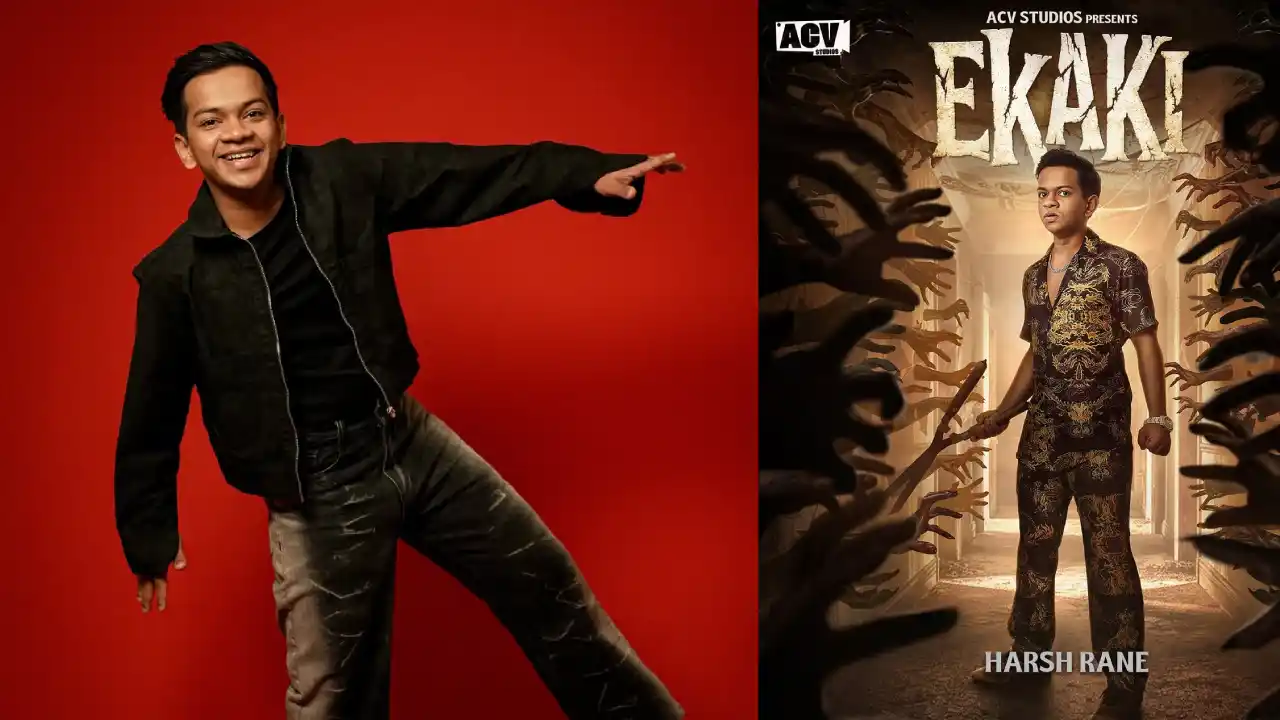
Popular content creator and actor Harsh Rane says that while social media has provided him with financial freedom and a distinct identity, he views the platform primarily as a safety net to support his lifelong ambition of becoming a Bollywood actor.
In a recent interview with digital media platform Social Ketchup, the 22-year-old breakout star of Ashish Chanchlani’s horror-comedy series Ekaki clarified his stance on the “influencer vs. actor” debate, stating that he would likely be struggling in college or failing auditions if he hadn’t pivoted to content creation during the pandemic.
Rane, who has amassed a significant following for his observational comedy reels, revealed that his career actually began in traditional media.
Before his first viral video, he secured a cameo in the Ranbir Kapoor film Brahmastra and played the childhood version of Manoj Bajpayee’s character in the Netflix anthology series Ray.
However, the inconsistency of auditions and the industry shutdown during the COVID-19 pandemic forced him to reconsider his path immediately after his 12th-grade exams.
He described his entry into the creator economy as a calculated gamble. Rane noted that while many peers were choosing secure college degrees, he bet on the exponentially growing digital market.
This decision transformed his financial reality, allowing him to purchase a home in Mumbai at the age of 22, a milestone he admitted would have been impossible solely through struggling actor wages.
He emphasised that content creation removes the desperation often felt by aspiring actors, giving him the freedom to choose roles without financial pressure.
Despite his success on Instagram, Rane was critical of how the mainstream film industry views digital stars. He argued that many casting directors now hire creators solely for their subscriber counts and marketing reach rather than their acting ability.
He expressed frustration with the perception that creators are merely tools for free promotion, asserting that many digital natives possess genuine acting chops that rival traditional talent.
Rane also drew a sharp distinction between his two personas, refusing to use his comedy reels as an acting portfolio. He explained that the “loud” performance style required to grab attention on a mobile screen is fundamentally different from the nuance required for cinema.
While he plans to continue growing his digital presence to maintain relevance and income, Rane remains firm that his legacy will be defined by his work on screen, not just his engagement metrics.