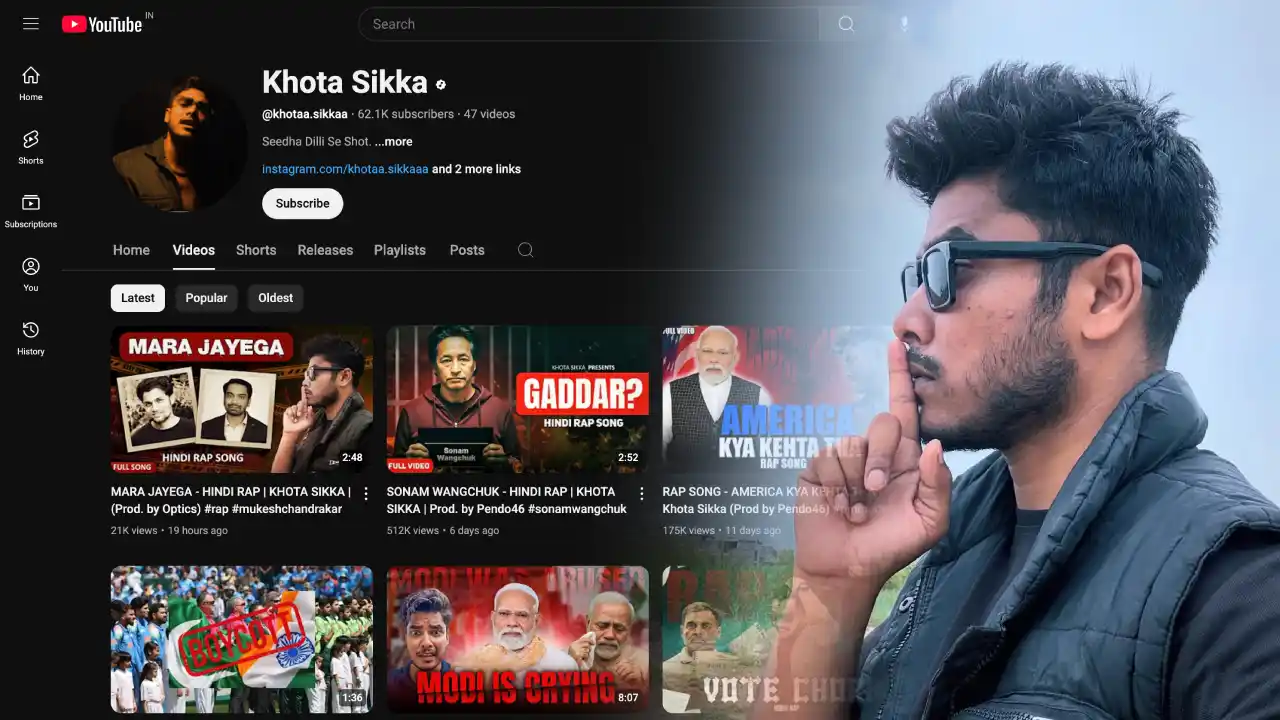
In the crowded world of Indian rap, Khota Sikka is emerging as one of the few voices that fearlessly marries style with substance. Based in Delhi and known online by the tagline “Seedha Dilli Se,” he is building a reputation not through gloss or hype, but through raw, socially conscious music that speaks to youth frustrated by injustice, apathy, and silence.
As of October 2025, Khota Sikka has not publicly disclosed his real name on official social profiles, interviews, or music releases. All verified sources reference him only by his stage name “Khota Sikka,” which he uses consistently across YouTube, Instagram, and music platforms.
Unlike polished pop-rap acts or chart-chasing artists, Khota Sikka’s rise has been organic and grounded. His tracks are often self-written, self-recorded, and paired with minimalist visuals that allow the message to shine through.
Songs like “Sonam Wangchuk” and “Tax Laga Do” exploded for their clever wordplay and bold critique, bits of his music circulate widely not because of big label backing, but because their message resonates. The latter track, a critique of tax burdens and inequality, has been shared thousands of times.
Khota’s roots are in the streets and the everyday. He raps about working-class life in Delhi, the grind, the pain of bureaucratic pressure, and the hope that still flickers in corners where the media won’t reach.
His verses sling both anger and introspection; he raps in a blend of Hindi and Urdu, weaving in references to current politics, press freedom, cultural identity, and youth disillusionment. The authenticity is unmistakable: you feel it in the accent, the imperfection of the recording, the urgency in his voice.
His social media footprint is steadily growing. With over 90k+ Instagram followers and an active YouTube channel, he doesn’t rely on flashy marketing or celebrity endorsements. Instead, he moves with community support.
He frequently collaborates with grassroots activists, independent beatmakers, and creators who share his vision of music as a tool for reflection, resistance, and healing.
Khota Sikka’s content cuts close to topics larger rap often avoids. His tracks touch on media suppression, state accountability, social injustice, and youth agency.
He has built subtle rebellion into his art, one line at a time. His tone isn’t preachy; it’s conversational, raw, and urgent. And in a culture that often expects artists to stay neutral for commercial gain, Khota’s refusal to compromise is part of what makes him stand out.
He also continues to perform locally, in college fests, street events, and small shows, staying reachable to listeners who hear him as their own, not as a distant star. He values dialogue over publicity, connection over spotlight. And for him, the merit lies not in fame but in impact.
In an industry often drawn to spectacle and virality, Khota Sikka’s grind is about material and meaning. His music may not always be radio-friendly, but it’s heart-friendly. And for many of Delhi’s youth and beyond, he offers a language for anger, uncertainty, hope, and the audacity to question.
His journey is still early, but Khota Sikka is already proving something important: in rap, sometimes the rawest voices carry the loudest weight. And when you speak from the street, truth finds ears.