

A heated debate has erupted in India’s startup world after Harsh Pokharna, the co-founder and CEO of OkCredit, accused fintech rival KhataBook of copying his company’s business idea and model. Pokharna’s candid post, shared on LinkedIn in late October 2025, went viral across the startup ecosystem, sparking discussions on intellectual property, ethics, and the thin line between “inspiration” and imitation in India’s booming fintech sector.
According to Pokharna’s statement, the KhataBook team allegedly replicated core elements of OkCredit’s product, including its user interface and features, soon after both startups participated in the same Y Combinator batch.
The claim has reignited old questions about originality in India’s fast-moving digital economy, where competition is fierce, and the race to dominate markets can often blur creative boundaries.
Harsh Pokharna’s journey to becoming a fintech founder wasn’t an easy one. An IIT Kanpur alumnus and serial entrepreneur, Pokharna launched OkCredit in 2017 with a mission to simplify bookkeeping for India’s micro, small, and medium businesses (MSMEs).
Before finding success, he worked at Flipkart and JioMoney, tried multiple startups that didn’t work, and faced long stretches of financial uncertainty.
Today, OkCredit is among India’s most trusted digital ledger apps, with over 3 million active users and investments from major global backers like Tiger Global and Y Combinator. Beyond his company, Pokharna also mentors young entrepreneurs and has invested in over 30 Indian startups, using his platform to advocate for transparency and ethical innovation in tech.
In his viral #harshrealities post, Pokharna set the record straight: “People think OkCredit copied Khatabook. Let me tell you the truth, we were in Y Combinator, same batch as the Khatabook founders,” he wrote.
According to Pokharna, OkCredit had already built its core product when KhataBook allegedly used similar design elements and business concepts to develop its version.
Both companies operate in the same niche, providing digital bookkeeping tools to small shopkeepers to track sales, payments, and credit.
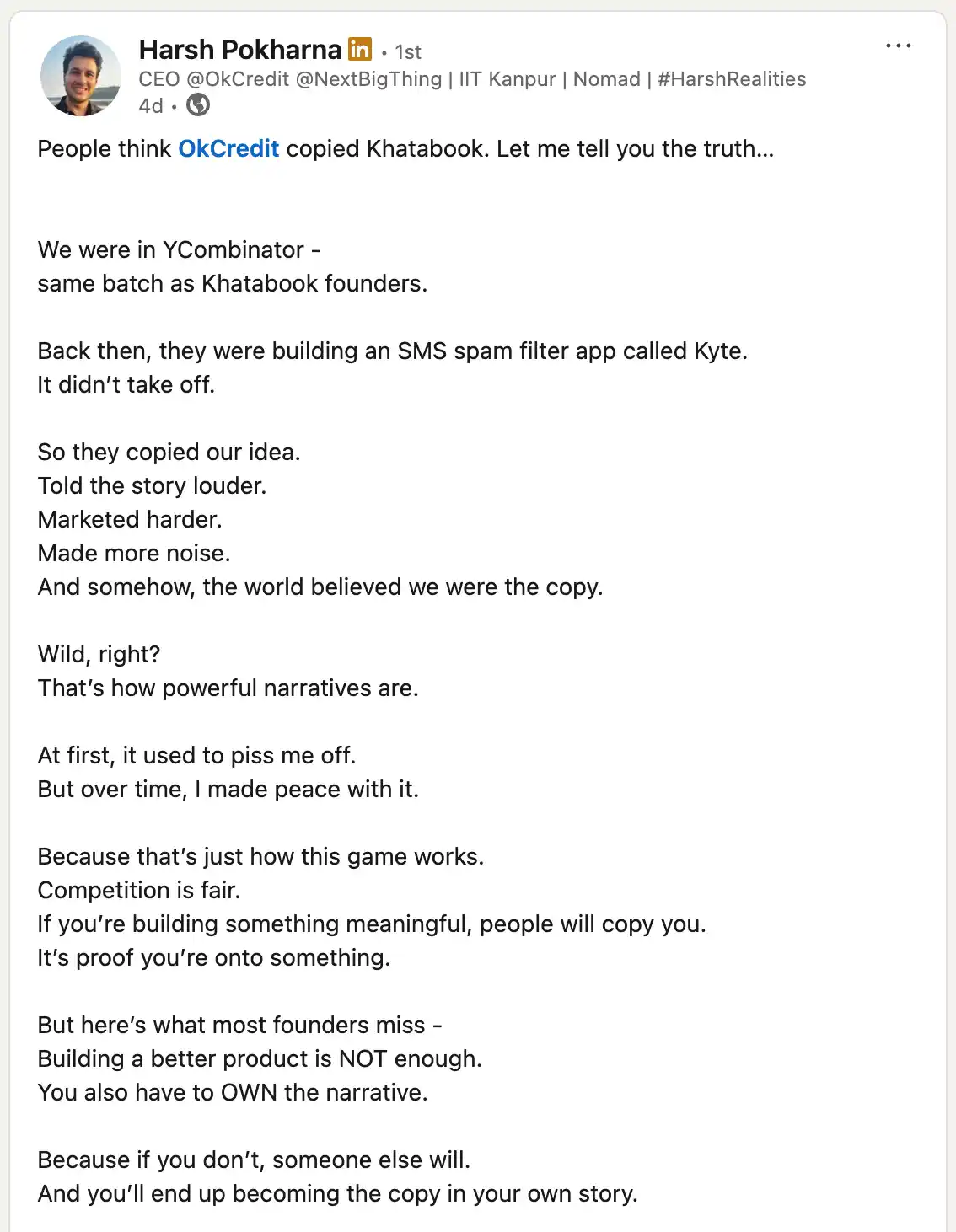
What makes the controversy even more striking is how closely the two apps resemble each other. Over the years, users and analysts have noted their near-identical interfaces, leading to ongoing speculation about who really started the digital ledger revolution.
Industry reports also reveal that this isn’t the first time KhataBook has faced plagiarism claims. According to Entrackr and Inc42, the company previously dealt with legal notices related to alleged UI copying, particularly in its Dukaan project — though KhataBook officially denied those accusations.
Pokharna’s revelation has sent shockwaves through social media platforms like LinkedIn, Twitter, and Reddit. Founders, investors, and startup enthusiasts have joined the debate, some defending KhataBook by saying that “ideas are common, execution is everything,” while others sided with OkCredit, praising Pokharna for his transparency and courage to speak up.
The post also sparked broader discussions about idea ownership in India’s startup ecosystem. Many believe that while competition is inevitable, startups must respect intellectual property and maintain integrity, especially when backed by major investors.
Pokharna himself used the moment to remind young founders that success rarely comes overnight. He shared that OkCredit’s rise came only after years of struggle, failed attempts, and relentless perseverance, not through shortcuts or imitation.
His message, according to Fortune India and CNBC TV18, resonated deeply within the startup community, inspiring conversations about building responsibly in India’s high-pressure tech landscape.
According to NDTV and Inc42, the OkCredit & KhataBook conflict has become one of the most high-profile disputes in recent years, given both companies’ visibility and investor backing. The controversy has exposed just how blurred the lines can get when multiple startups chase the same market opportunity, and how critical ethics and transparency are to building trust.
Pokharna’s public statement has turned into more than just a personal defence. It’s now a case study on startup culture itself, one that challenges India’s entrepreneurs to think deeply about what it truly means to innovate.
Whether this controversy leads to formal legal action or just industry introspection, one thing is clear: in the race to build India’s next fintech giant, originality still matters.