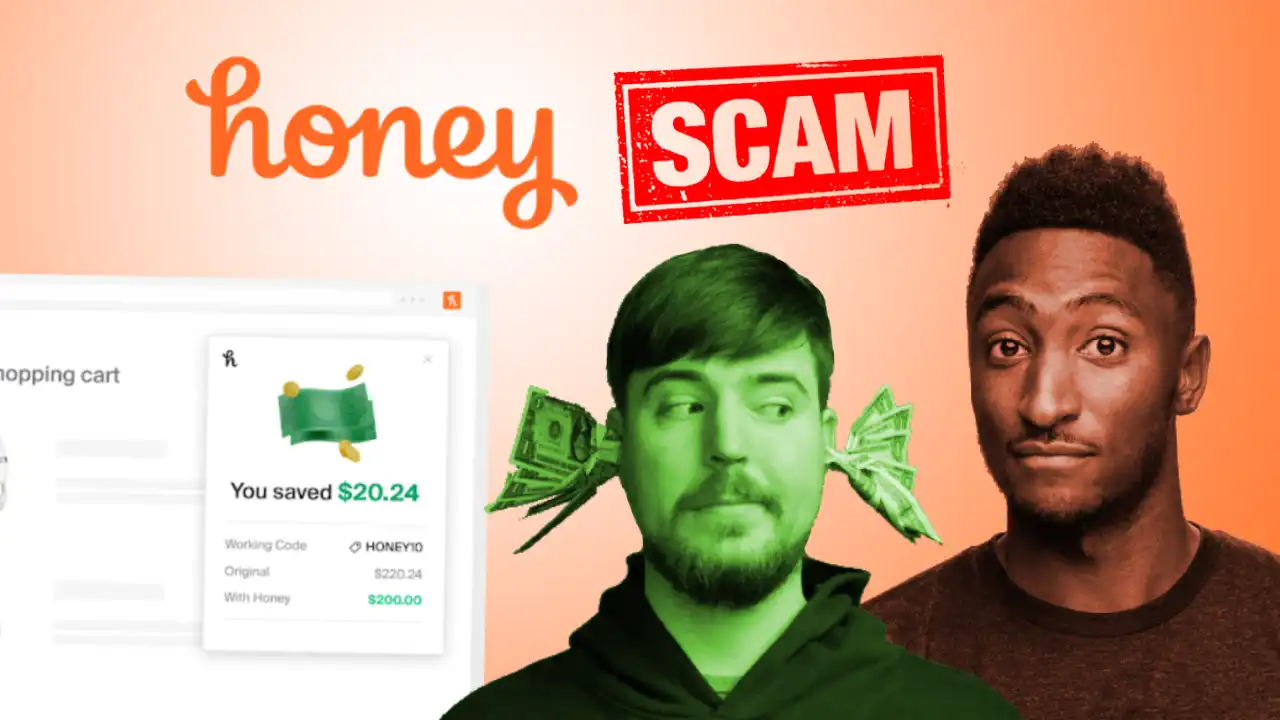
PayPal Honey is a browser extension that claims to find the best coupons for online shoppers by applying them right at the checkout page. A YouTuber named MegaLag has recently accused Honey of being the biggest scam in the creator economy stealing affiliate revenue from the creators who promoted it, and also not finding the best coupon codes for consumers.
Some of the biggest influencers like MrBeast, Marques Brownlee, Linus Tech Tips and many others have earlier promoted it in their sponsored videos without knowing that the free browser extension is stealing their money from their back pockets.
The 23-minute video by MegaLag has revealed some very shady business practices used by Honey which was acquired by PayPal in January 2020 for approximately $4 billion in cash.
To understand the Honey scam, you’ve to first learn how affiliate marketing works.
What is Affiliate Marketing?
Affiliate marketing is a very common way for brands to promote their products and services where they give a commission to people who bring customers to them without overcharging the customers.
YouTubers and bloggers make a major chunk of their revenue from affiliate marketing. They usually place their affiliate link in the video description and whatever sale happens after clicking on their link, they get a commission for that.
Most affiliate programs work under the system of last-click attribution which means no matter how many affiliate links you click, the last link you clicked just before making the purchase will be attributed for the sale and get the commission.
What’s the Honey scam?
The Honey browser extension claims to find the best coupons just on the checkout page. Now let’s say, you watched a video on YouTube about a product and clicked on the affiliate link in the description to make a purchase.
But as you land on the checkout page, there’s a popup of Honey extension saying they’ll find the best deal and you click on that. Whether Honey finds a coupon or not, it just replaces the affiliate link tracking cookie of its own overriding the YouTuber’s affiliate code due to the system of last-click attribution.
This is how Honey makes money by injecting its own affiliate code right at the checkout page no matter whose affiliate link you clicked to make a purchase.
Not only that even if you don’t click any affiliate link, and you just open an online store to buy something Honey will pop up to give you discount coupons and they’ll place their affiliate code and make money no matter if you get the best deal or not.
Anytime you click on the Honey browser extension on the checkout page, it will inject its affiliate code and make money from you which is just the opposite of what it claims — to save your money.
Shady business practices of PayPal Honey
First of all, Honey is stealing affiliate commissions of content creators by injecting its own affiliate code.
The other shady thing is it’s not providing the best discount coupons even for the customers. The MegaLag video also revealed that Honey partners with online stores and brands to limit the discount percentage and control the coupons shown in the extension.
It means that even if there’s a great discount coupon available if a consumer is using the Honey extension, it will show a coupon code with minimal discount or simply say that it didn’t find one. This is just the opposite of what it claims to be and how it markets itself.
What’s now?
As the investigative video of MegaLag came onto the public radar, more and more YouTubers have come forward to talk about this and some of them have also filed a class-action lawsuit against PayPal, the company which owns Honey.
Marques Brownlee, one of the top tech YouTubers also known as MKBHD, published a video on his channel explaining the scam as he too had promoted the extension in three videos around 2020.
He has now removed the ad part from his videos through the YouTube dashboard editor and said it’s time to get super selective about sponsors on YouTube.
“If I had known any of this, I never would have worked with Honey, and neither would the creators who did. But clearly, nobody knew about this going on,” he added asking the viewers to uninstall the scammy extension.
Austin Evans, another famous tech YouTuber who often makes videos exposing tech scams, rightly said in his video that they’re paying creators upfront for the sponsored ads and then stealing from their back pockets.
The MegaLag video claimed Honey to have sponsored more than 5000 videos amassing 8 billion views, and now as the situation gets public it’s evident how shady brands can use the creator economy to play with people’s emotions for making more money.
It’s high time creators double-check the brands they’re promoting and also for the viewers to not believe in everything that’s thrown at them on the Internet.