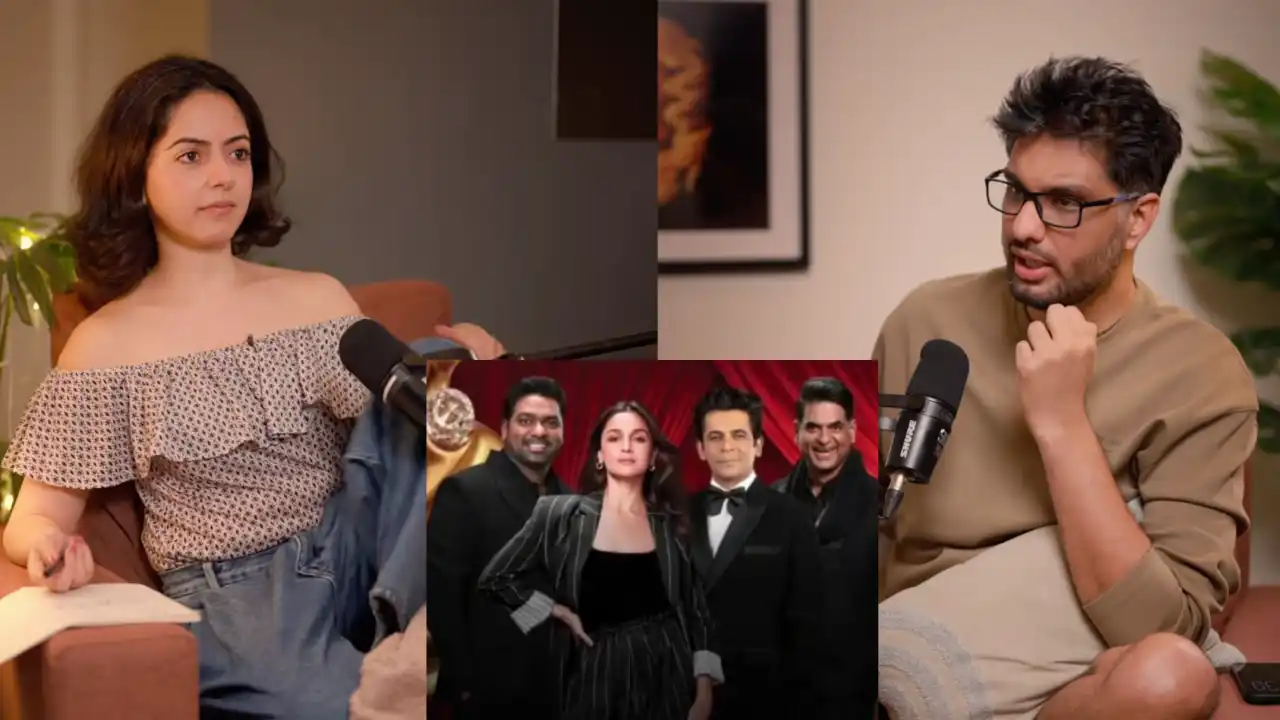
Popular stand-up comedian and co-founder of the former comedy collective AIB, Gursimran Khamba, recently joined his wife, Ismeet Kohli, on their podcast to critique the chaotic execution and controversial moments of the Chetak Screen Awards.
The couple discussed a range of viral incidents involving A-list celebrities and creators, questioning the creative integrity of modern Indian award ceremonies.
Khamba, who has previously written for high-profile industry events, noted that these shows have shifted from being prestigious honours to highly processed television content designed primarily for brand deals and social media clips.
The centerpiece of their discussion was the series of awkward stage interactions involving comedian Zakir Khan and superstar Alia Bhatt.
Kohli pointed out a specific moment where producer Goldie Behl allegedly critiqued Khan’s hosting performance while on stage, prompting a swift and witty defence from the comedian.
She noted that Khan’s ability to navigate these high-pressure social hierarchies reflects the growing influence of “Creators” over traditional industry stalwarts.
Kohli and Khamba explained that these “cringey” moments often go viral because they highlight the visible egos that still permeate the Bollywood ecosystem.
Another significant topic was the viral clip involving Nita Ambani, the chairperson of Reliance Foundation, and Alia Bhatt. While the internet was ablaze with rumours that Ambani was offended by being addressed as “Bhabhi” (sister-in-law), Kohli clarified that much of the controversy was fueled by edited reels.
She emphasized that the public often gatekeeps how celebrities should behave, leading to unnecessary “hate-trains” against figures like Bhatt.
Kohli argued that the obsession with these small interactions distracts from the declining creative standards of the actual awards.
The pair also delved into the “Invisible String Theory,” a popular social media concept suggesting that people are destined to meet based on cosmic timing.
Kohli used this to explain the interconnected nature of the Indian creator economy, where influencers, actors, and cricketers often cross paths in the same “socio-economic circles.”
They also discussed the “Virat Kohli Effect,” where a single social media interaction from the cricket icon can fundamentally change a creator’s career overnight.
Kohli expressed concern that this focus on virality is pushing creators to prioritize “clout” (influence or power) over original storytelling.
The analysis concluded with Kohli and Khamba questioning the “utility” (usefulness) of having multiple, repetitive award ceremonies every year.
Kohli noted that for many artists, these trophies no longer represent a “gold standard” of excellence but are instead viewed as “marketing props.”
With the rise of OTT, the duo argued that audiences now crave the raw honesty of podcasts and behind-the-scenes commentary over the scripted “bakchodi” (frivolous talk) of traditional televised galas.