
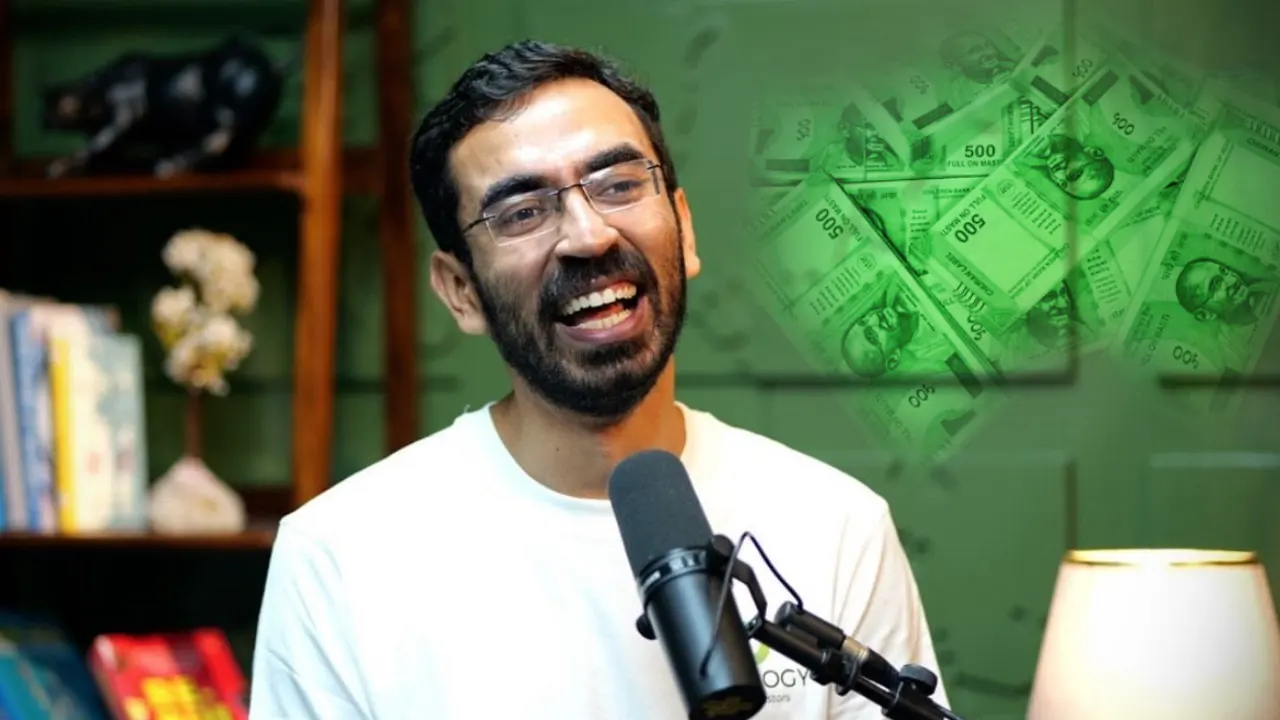
Raipur-based fintech founder and popular finance influencer Pranjal Kamra has pulled back the curtain on his bootstrapped empire, revealing that while his company Finology might be valued near ₹100 crore, his liquid net worth is a fraction of that figure.
Speaking on The Creator Room podcast, Kamra detailed his strict refusal to promote products he doesn’t use, specifically insurance schemes, and explained why building a startup in a Tier-2 city was his competitive advantage.
Kamra, who runs one of India’s largest finance YouTube channels with over 6.4 million subscribers, clarified the sensationalised headlines about his wealth. While he estimates his business valuation between ₹50-80 crore, he emphasised that his “real” net worth, money he can access immediately, is closer to ₹15-20 crore.
He argued that paper wealth is often an illusion, noting that even billionaires cannot liquidate their holdings without crashing their stock price.
Pranjal Kamra launched Finology in 2017 from Raipur, initially as a blog and later expanding into a YouTube channel, which now boasts over 6 million subscribers. His platform Ticker has become a staple for Indian retail investors, further decoupling his income from the fluctuating views of social media algorithms.
By keeping his operational costs low in a Tier-2 city and refusing to dilute equity to venture capitalists, Kamra retains full control over his revenue, allowing him to bypass the “view-chasing” rat race that traps many creators.
The “Anti-Influencer” Business Model
In a landscape where creators often rely on multiple revenue streams, Kamra disclosed that AdSense (YouTube advertising revenue) is a negligible part of his income.
Instead, he has built a vertical-integrated business where his content serves as a funnel for his own products, primarily the stock analysis tool Ticker and legal education platform Finology Legal.
His approach to brand partnerships is notably aggressive. Kamra admits that he charges approximately ₹10 lakhs per brand integration, but claims to reject nearly all incoming sponsorship requests, particularly from insurance manufacturers and direct-to-consumer brands that demand positive reviews.
Instead, he only partners with platforms he personally uses, such as Zerodha or Ditto, and demands year-long contracts to avoid the volatility of campaign-based marketing.
Kamra describes his monetisation philosophy as “long-term greed.” He admitted to being a capitalist who wants to earn from the industry for the next 60 years, which forces him to protect his audience from low-quality products today. This approach has led him to prioritise affiliate income that does not inflate costs for the user.
Raipur Over Bengaluru
Contrary to the trend of founders moving to Bengaluru or Mumbai, Kamra credits his decision to stay in Raipur, Chhattisgarh, for his company’s stability. He explained that in a smaller city, Finology acts as a “talent magnet” similar to how Google or Uber are perceived in metros.
“If I move to Mumbai, well-funded startups will poach my team with 3x salaries within months. In Raipur, we are the aspirational employer,” Kamra noted.
This retention strategy has allowed him to build a stable team and profitable business without external venture capital funding.


Advice for Aspiring Creators
Pranjal Kamra offered sharp advice for new creators, warning them against “Plan B” thinking. He argued that having a safety net often prevents creators from fully committing to their primary goal. He also urged creators to ignore algorithms in their early days.
“If 100 people watch your video and share it on their family WhatsApp groups, no algorithm can stop you. But if you optimise for the algorithm first, you lose the human connection,” he advised.