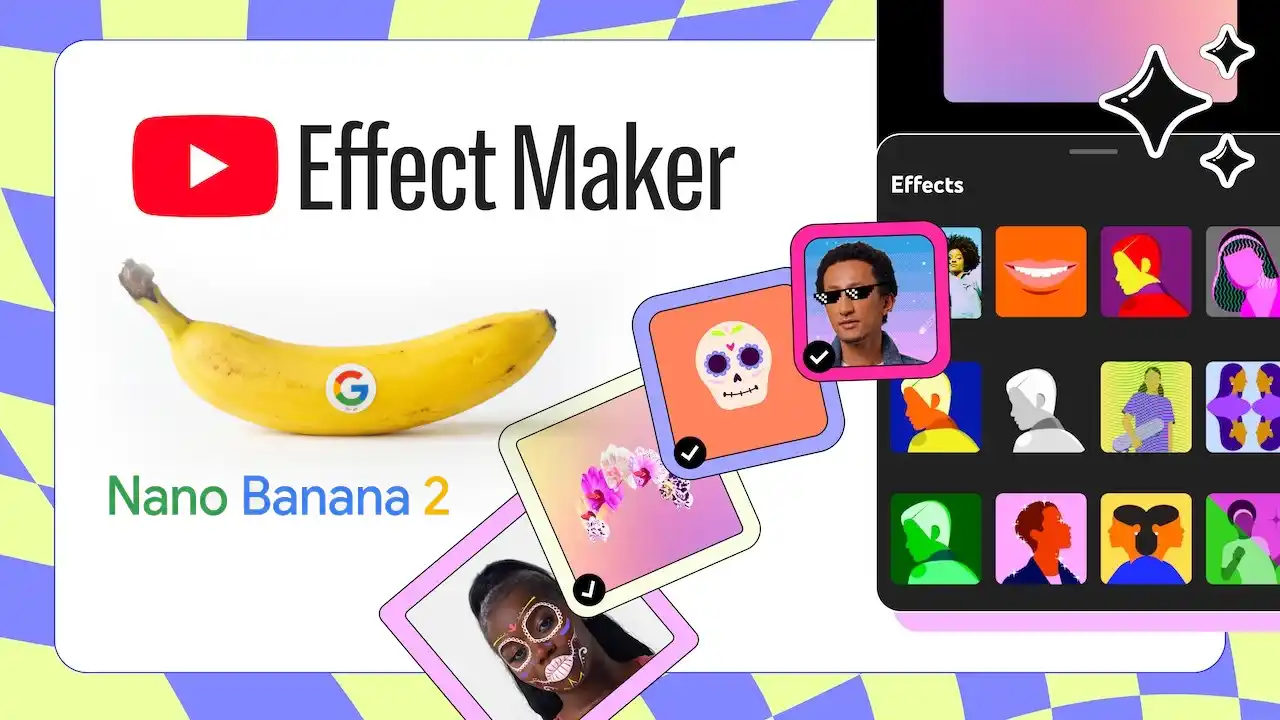
YouTube expanded its generative artificial intelligence suite on Friday by rolling out Nano Banana 2 within its proprietary Effect Maker platform to give eligible video producers the power to generate immersive, photo-realistic backdrops and face filters.
The latest update to the web-based creation hub allows desktop users to transform standard smartphone selfies into completely customized environments, eras, or alternative realities using nothing more than simple text descriptions.
The rollout targets thousands of digital content creators across India who are looking to scale up production quality and boost visual engagement across the video platform’s fast-growing short-form vertical.
According to a public product announcement shared by the official YouTube Creators team, the new Nano Banana 2 framework is integrated directly inside the AI Image creation module of the web portal.
To utilize the new capabilities, digital media producers must navigate to the desktop dashboard, log into an eligible channel, and activate the precise creation mode within the generative workspace.
The platform uses advanced text-to-image processing to construct dynamic layers that can then be published globally for any general user to record with when filming interactive short-form videos.
As outlined in the official technical documentation, the design dashboard is currently restricted to desktop computers and requires channels to hold advanced feature access, which is an elevated eligibility tier unlocked by building channel history or completing video verification.
Aspiring video producers should note that published interactive designs can act as powerful discoverability funnels because individual attribution links are placed directly on any short-form clip that utilizes the specific visual asset.
To assist independent developers with the learning curve, the company launched an official tutorial playlist and established a dedicated communication server on Discord where asset designers can interface directly with internal engineering teams.
The web-based design system represents a significant strategic pivot for the digital entertainment platform as it attempts to construct an open-source visual ecosystem to compete against rival interactive design platforms like Snapchat Lens Studio and Meta Spark.
Beyond standard filters, the creator portal provides visual scripting nodes and triggers that react when a viewer taps the mobile screen, drags an asset, or performs specific head gestures.
The tech company also added body segmentation, an automated computer-vision process that separates a foreground subject from their background environment, to let developers seamlessly isolate creators from their real-world surroundings.
The expansion comes as the tech ecosystem experiences massive growth across regional markets, with short-form video consumption driving significant monthly active user metrics among mobile first audiences throughout South Asia.
The platform originally debuted its standalone creation workstation last year to democratize the production of interactive face modifications, three-dimensional digital accessories, and custom particle engines.
Independent visual assets can also be showcased directly on a developer’s main channel feed, serving as an additional portfolio driver as brands increasingly scout specialized creative talent for major digital marketing partnerships.