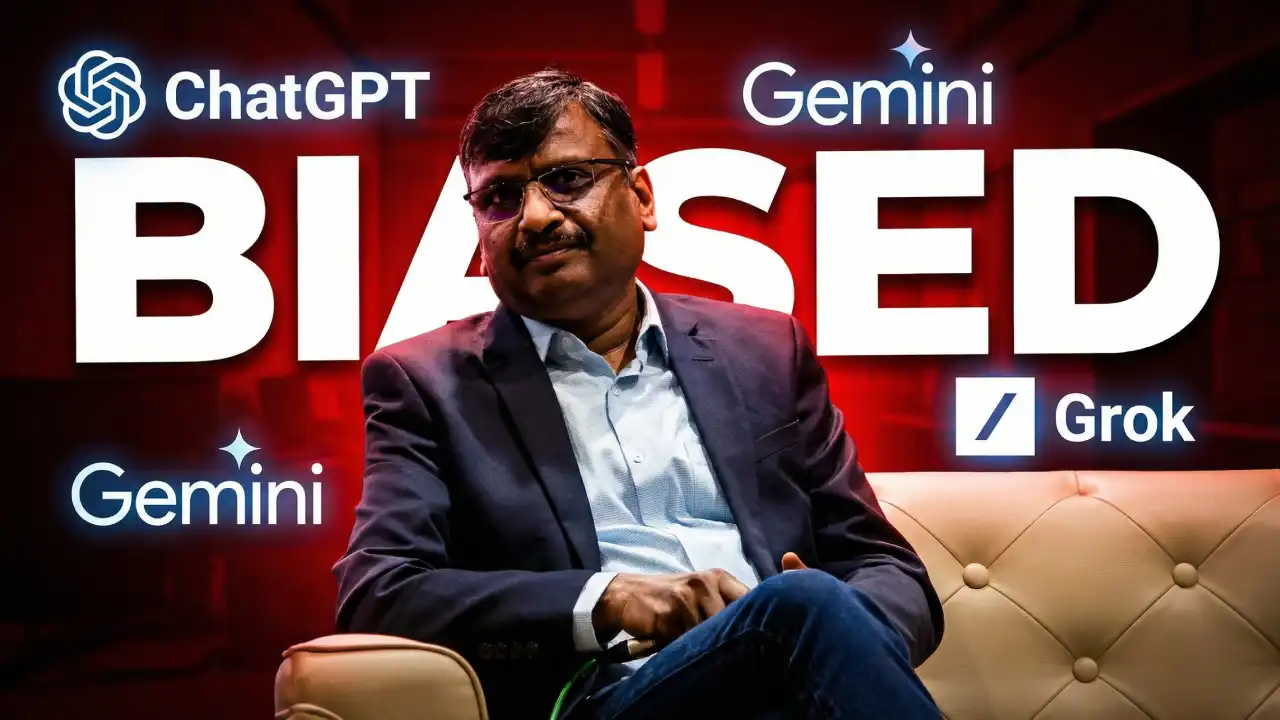
Popular educator and prominent UPSC interviewer Dr. Vijender Singh Chauhan has addressed a growing controversy regarding his recent critiques of artificial intelligence, asserting that bias in AI is a documented reality rather than a mere belief.
Chauhan, a respected academic with over 15 years of experience at the University of Delhi, clarified that Large Language Models (LLMs), the technology behind tools like ChatGPT and Gemini, frequently reflect the prejudices of their training data.
He specifically highlighted that these models often favour dominant social groups, such as upper castes in India, because they are “pre-trained” on vast datasets that already contain historical human biases.
The discussion gained momentum after a short video of Chauhan went viral on X and Instagram, where he pointed out that ChatGPT’s outputs can be skewed toward “Savarna” or upper-caste perspectives.
In a follow-up clarification, Dr. Vijender Chauhan explained that the term “Generative Pre-trained Transformer” (GPT) itself points to the problem: the model is trained on existing content that often lacks representation for marginalised communities like Dalits or Adivasis.
He argued that if the foundational data is flawed, the resulting AI products cannot be expected to support social justice unless developers take aggressive steps to de-bias them.
Chauhan warned that relying blindly on these tools can lead to the reproduction of stereotypes that harm millions. He cited recent reports, such as a 2025 study by MIT Technology Review, which found that OpenAI’s models often associate certain castes with high-status roles while linking Dalits to stigmatised or menial labour.
This creates a “digital panopticon” where automated systems reinforce old inequalities in a new, tech-driven format.
Dr. Vijender Singh Chauhan is a widely recognised face in the Indian education space, known for his viral mock interview clips at Drishti IAS, a leading civil services coaching institute. He holds a PhD from the University of Delhi and has authored multiple books on media and gender studies.
With a massive digital presence that has garnered millions of views, Chauhan’s transition into tech ethics highlights a significant shift in how thought leaders are challenging the perceived objectivity of global AI giants.